
PartnerStack - Helping Sell Software
Partner Relationship Management (PRM) Software
"Alone we can do so little; together we can do so much." – Helen Keller

Surprisingly (to me), this also seems to be the case with software sales…
At SaaS Connect 2019, Rob Belcher, managing director at SaaS Capital provided some interesting data on software channel partnerships.
He noted that more than half (53%) of B2B SaaS companies have some kind of partnership channel program.
Of those 53% of companies, on average a little more than one-fifth of revenue comes via the channel. Those companies tend to grow a bit more quickly than companies that only sell direct, too.
Clearly, partnerships are critical to the distribution, growth, and scale of software companies. Those that don’t leverage the power of partnerships literally miss out on a massive chunk of their potential total sales.

What are partnerships (or partners) you might ask?
Partners are individuals, consultants, or companies that sell or help you sell your product or service.

There are 3 main types of partnerships:
Referral Partners - Referral partners are those that refer customers to use your product in exchange for a small reward. I wonder what a good example of this might be….
Sign up for Amex Gold using my referral link and get $600 in travel credit! Or sign up for Chase Freedom Unlimited no-fee card for 3% back on restaurants / dining!
Sign up for DraftKings or FanDuel sportsbooks using my referral codes linked (shameless plug lol)
In need of the best VPN to watch Netflix and such in other countries? Use my referral code for Windscribe too!
By getting you to click and signup or use the product, I get a small reward, and I am essentially functioning as a referral partner.
Affiliates - Affiliates are typically content creators and influencers who use unique links and cookies to strategically target users in the consideration phase of their buying journey to get end-users to click and consider your product.
This might be a content creator promoting GymShark, any clothes or shoe brand, or even skin-care products because your cookies have told algorithms that you are interested in products of these types.
Resellers - Resellers can be individuals or agencies that literally resell your product and typically receive some type of revenue share or commission.
A great example of this is ServiceRocket, a reseller partner that helps companies like Atlassian and Salesforce sell their product and deal with customer success around the world in regions like Asia, Australia, Europe, North and South America
What effects can Partners have on your business?
Partners enable you to divide and conquer your sales efforts in a few different ways by outsourcing the work. First, partners help present your software to a larger audience and generate more leads you might not get otherwise. Importantly, they market your product to audiences that are actually relevant to you. Secondly, partnerships drive revenue through a new channel outside of direct sales, which saves your sales team time and effort! Some partners can even help with international product expansion as they may understand culture, language, and customs better than you can. If done correctly, partnership programs can fuel increased revenue, higher customer lifetime value (LTV), and reduced customer acquisition costs (CAC).

Integrating with the right systems and partner programs can mean the difference between a closed deal and a non-existent one.
Typical partnerships are managed ad-hoc using things like spreadsheets and emails, poorly built websites, and more. But Partnerships are an important part of a business’s revenue and are highly complex. Partners and partnerships come in all shapes and sizes. Not only does any-one software company have many but there are partners of different types and sizes, partners with different compliance and regulation needs, and different communication channels needed for each one.
Where do typical partnership platforms fall short?
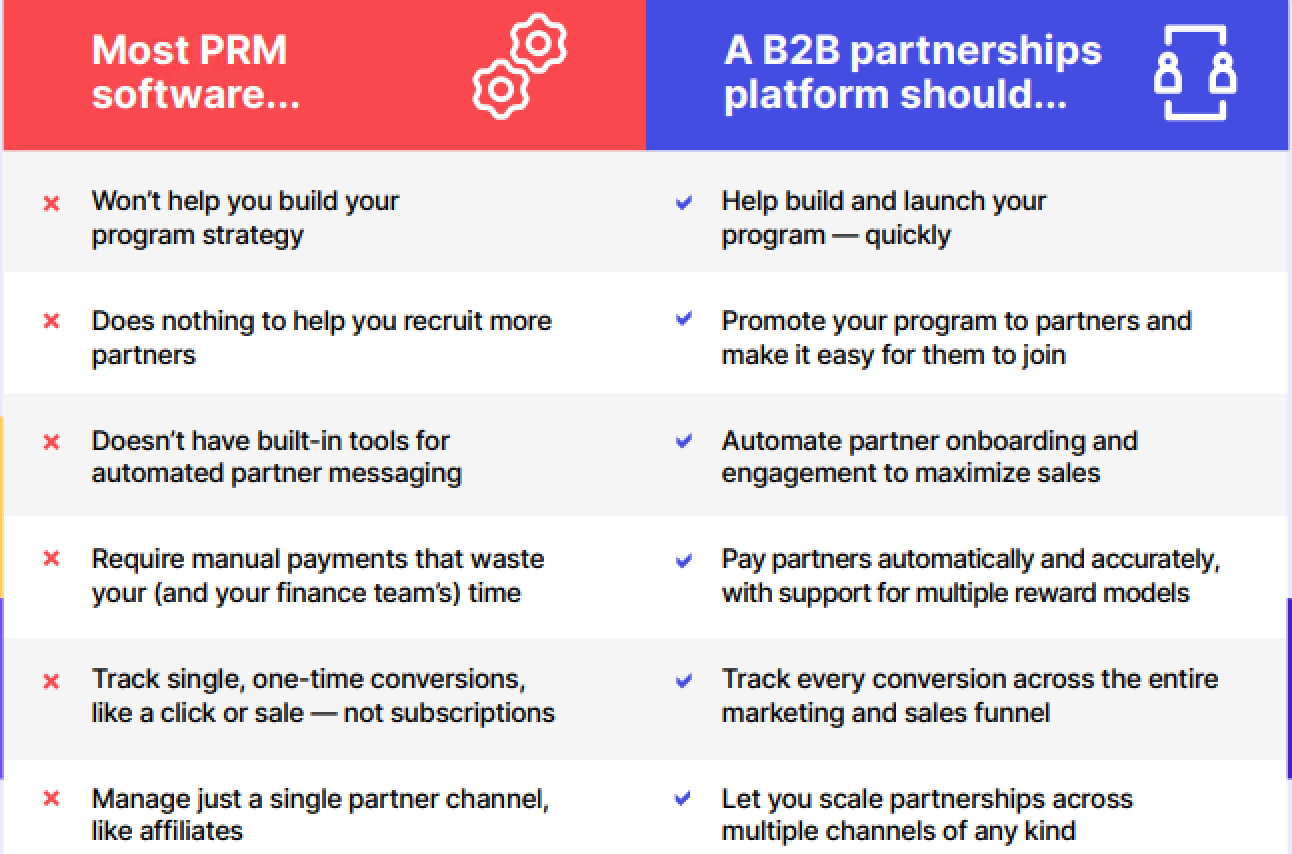
Enter PartnerStack, a Toronto-based startup designed to create and support revenue channels for software. PartnerStack is an integrated partnership relationship management (PRM) platform that helps solve the sophisticated administrative nature of SaaS channel sales and partnerships. In May of 2021, PartnerStack raised $29MM from 3L, with investors such as Whitecap, Harbourvest, and RRE also participating.

The PartnerStack platform is an integrated suite for partnerships that supports B2B Vendors in managing and scaling their Partner revenue on one platform. For a simple product overview, check out this quick video from a PartnerStack tweet below:

If you want to see their full demo, I’ve left the video at the bottom of this post.

PartnerStack’s portal enables software vendors to set up custom applications, onboarding, and training for their potential partners. A vendor can then list their program in the PartnerStack Marketplace to reach thousands of experienced partners. PartnerStack automates recruiting the best partners, onboards them onto the program, and rewards them for every successful conversion. PartnerStack can also build bespoke actions such as automated emails and offers for partners based on their behavior and performance.

Finally, a vendor can choose to upgrade some of their partners to new “tiers” and offer bonus incentives based on performance, completing certification courses, and more.
Over time vendors recruit additional partners onto the platform. Partners can also join and apply to serve multiple software vendors. This creates a strong flywheel and two-sided marketplace with network effects.
The Partnerstack portal gives companies clean insight into attribution and reporting of revenues each partner has generated, their commission, and the impact it has on your top line. Finally, PartnerStack has extensive commission and compliance integrations. PartnerStack has won awards for G2 Top 50 Product for Sales 2021 as well as G2 Top 100 Fastest-Growing Products 2021. PartnerStack also has many blue-chip customers comprised of companies like Asana, intuit, Webflow, Unbounce, monday.com, Freshworks, Intercom, Evernote, Aircall, and more.
The Market
Partner relationship management (PRM) is a set of software and strategies that companies use to enable smooth business relationships with those they partner with on marketing and those that sell their products. PRM can range from simple approaches for managing co-marketing relationships to complex programs involving sophisticated software and data-management
MarketsandMarkets estimates the Global Partner Relationship Management (PRM) market size will grow from $920MM in 2020 to $1,997MM by 2026, at a CAGR of 13.8%. The ability of products to capture the PRM space is driven by:
PRM platforms should enable vendors to have complete, flexible, and totally customizable control of their relationship with partners of varying types
PRM platforms need to focus on the enhancement of partner communication and reduction in channel management costs.
PRM platforms should prioritize data security needs and privacy constraints.
Future opportunities for PRM growth include:
Increased Business intelligence (BI) solutions for better channel performance
Incorporation of AI into PRM to optimize partner engagement
The risks
PartnerStack markets itself as a PRM for any type of B2B SaaS company. Appealing to “anyone” is a difficult target to hit; as the phrase goes “if you try to please everyone, you will please no one”. PartnerStack must provide a solution that will provide a custom-tailored solution for every vendor and partner, but the needs of each partner and software vendor are unique. PartnerStack should be careful not to isolate any of them with its broad offering. Claiming to have such range means the solution needs to be robust, cost-competitive, and versatile.
In the same vein, how many software vendors do not need official partner programs built, integrated, and managed through a 3rd party PRM platform? Some startups might be so small they prefer to build referral affiliate programs internally. They may not even want to (or afford to) pay a subscription fee to have access to the marketplace. Additionally, some startups might function in niche sectors (e.g. real estate media) where a partner marketplace may not be that much of a value-add since most potential end customers are easily targetable through direct sales channels.
PRM solutions exist in a highly competitive and saturated space with multiple contenders at each spot in the sales channel funnel. For any given vendor, there are several different PRM solutions dependent on company needs, budget, partner onboarding requirements, features, integrations, etc. For companies that already use a horizontal software solution such as Salesforce, it may make more sense to not use PartnerStack as the incumbent is more convenient, streamlines workflows, has integrations, and reduces context switching.
More generally on the business model, PartnerStack needs to beef up entities on both supply and demand sides of the partnership marketplace, otherwise the platform’s flywheel will fall apart. Additionally, it should be careful to monitor its (or take rate) from the partner reward side so as not to disincentivize partners from resorting to others PRMs.
Last week
I made a spontaneous decision to fly to Paris.
My sister graduated from Duke a year early and has been traveling the world. She spent 2 months backpacking through Asia and now has been taking a very cool art class in Paris.

After some thought, I decided to rip a flight to Paris on Wednesday night to visit her for the weekend! As is Wolfe tradition, we did more eating than anything else. Tried some escargot, soufflé, and many other types of french food; it was truly extraordinary. Gave a cardigan a try while I was there but decided I’m not ready for that level of sophistication just yet…


GW
As promised, see the full PartnerStack Product Demo below: